Revised/modified on 11/15/11 (new photo, new links)
 |
A sidesaddle from the Regency period.
The horns are in the 'bullhorn' configuration,
where the right thigh would rest. There is
no leaping horn. The seat is "Sweepy"
The stirrup is a 'slipper stirrup'
And far from safe. |
I’ve rekindled my interest in riding aside these past few years, naturally. Depending on the level of interest, I'm thinking it would be fun to create a 'ORS Equestrian' division, and hold field days and costume-classes and more. But that's in the future. But my interest in returning to 'riding aside' has come closer to fruition. Recently I was able to make a fortunate trade; my beautiful Courbette dressage saddle for a 30-year-old sidesaddle (possibly 40). Yes, it might seem something that is not a fair trade, but understanding how rare new (and well made) sidesaddles are in general, if you can find a good vintage saddle that fits your horse, you’ve done well.
Please scroll down to the bottom of the page to find a listing of sidesaddle sellers both domestic and foreign, with a details, pricing comparisons and recommendations. These saddles are made for modern horses. I have also provided a number of other sidesaddle-related links at the bottom of the page.
Anatomy of the modern sidesaddle:
 |
| The near-side top |
 |
| The near side under the flap. |
 |
| The off-side. |
The near side is where the legs are placed. This is on the left side/mounting side of the horse. The off side is the right side of the horse. These photos are courtesy of the
International Sidesaddle Organization. This diagram is of a typical style, but styles do vary.
Off-side saddles do exist, meaning that there are sidesaddles where your legs would be on the right side of the horse rather than the near-side or mounting side, which is traditional. Some custom saddlers do make these off-side saddles. Tattersall's for instance has one featured on her website. Scroll down to the link list for details.
There are generally two kinds of sidesaddle seats; a "Sweepy" sidesaddle, where the seat looks much like a traditional English saddle, with the dipped center and higher cantle (or back); and the flat sidesaddle, as pictured above, with a seat that is pretty much a flat surface. Some of these have symmetrical seats, and others have seats that are J shaped to conform to the asymmetrical position of the rider's derriere. Most modern riders will recommend the flat seat over the sweepy seat because the sweepy seat tends to feel 'uphill' and gives the rider the sense of sliding backwards, and having to lean forward too much.
 |
| Position on a flat sidesaddle. |
The saddle I have has a flat symmetrical seat, and a wide tree. Wide trees are hard to find in vintage saddles; considering that most of the older saddles are designed for non-modern horses, which were shaped differently than today’s horses--meaning they had narrower and taller withers. It is unfortunately not wide enough for my rather portly draught horse in spite of its unusual width. Saddle trees, for those of you who don’t know, are the frames on which saddles are built. There are wooden trees, steel trees and all manner of other materials, including fiberglass. They are built to conform to the shape of a horse’s back and withers so that the weight of the saddle is directed to the sides of the saddle, leaving a channel down the center to protect the spine.
 |
An example of a sidesaddle tree (courtesy of Zaldi saddles)
You can see the fixed horn, the two adjustment-holes for the leaping horn,
and the breakway stirrup bar assembly (the brass). This is rigid, strong
construction meant to carry the stresses of a sidesaddle rider. |
An ill-fitting tree can cause discomfort and injury to a horse’s spine, withers and more. Sidesaddles on the most part have unusual construction because the rider sits asymmetrically and requires more support on one side. In modern sidesaddles, there are a series of measures that are taken in the design to insure that the saddle doesn’t rotate/twist under the weight of the rider, that it doesn’t create pressures on the horse that might create discomfort or even cause injuries, and to prevent the saddle from slipping and rolling under. When the weight is concentrated on one side, a saddle needs to be an extraordinarily good fit on the horse to prevent injury, slippage, rolling or twisting. Flocking (stuffing) underneath the saddle needs to be done carefully to conform to a horse’s shape. Bad flocking or insufficient flocking can naturally also be a problem. With sidesaddles, having a proper fit is especially important.
So when trying to pursue becoming a sidesaddle rider, ladies need to keep in mind that fit and safety should be the two most important considerations when shopping for a sidesaddle. It is more important than authenticity, I’m afraid. So if you are a die-hard reenactor, I’m afraid it would not be advisable to have a saddle made to emulate the Regency period sidesaddle unless it had modern measures built in to compensate for the Regency design's flaws. In fact, any saddle style prior to the Victorian sidesaddle would not be safe for you or for your horse. Even antique late Victorian saddles, if you can find them, must fit your horse well enough as to prevent any issues, and may require modification. Most saddles available today that are antique or vintage hail from the 1920s & 1930s. Very few older than that exist today, and if they do, they are not the safest saddles to have, except when kept for display.
|
|
This little period-cartoon demostrates (in a subtle, vulgar way) that in the Regency period,
the idea of ladies riding astride was considered improper.
|
For the reenactor, it really isn't advisable try for accuracy. The Regency and Georgian sidesaddle was not a safe saddle by any means. For one, it lacked a leaping horn, which provides a greater measure of security for the rider. The near flap is also very large and could inhibit contact with the horse. This article from Regency Redingote describes
the pitfalls of regency saddles most aptly. Modern saddles also have breakaway systems for, if in the eventuality of a fall, that your foot is released from the stirrup. At the time, the balance girth also did not exist, which is one of the methods that helps keep the saddle secure and prevent it from twisting/rotating and putting undue strain on your horse’s body.

For the historically inclined, you might enjoy this little link:
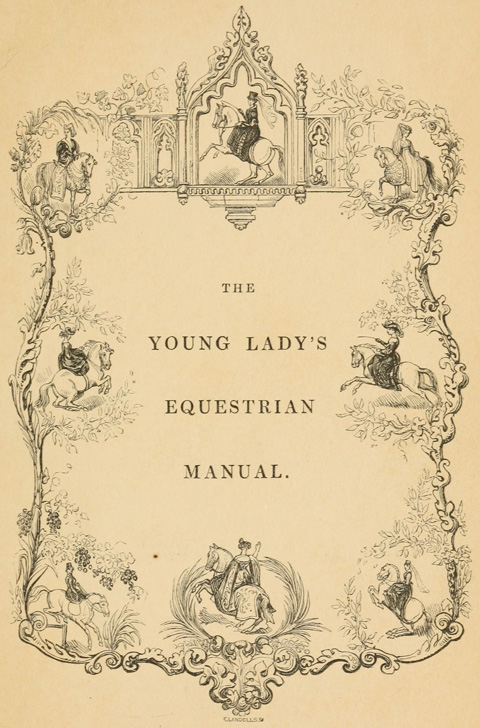
Project Gutenberg's The Young Lady's Equestrian Manual. This online publication has a lovely array of images and tips for the 18th and 19th century rider. Keep an eye out for the images of the bullhorn sidesaddle, which is shown quite frequently. This is a wonderful resource for anyone researching period sidesaddle riding.
You can download a .pdf version of this book here.
Accessories: The Groom's Stirrup.
It happened sometimes that a lady's horse had to be ridden by a groom; perhaps the lady was too tired to ride back, and took a coach, or whatnot. Attached to the saddle would be a small pouch that would carry a stirrup with a special stirrup leather that attached to the off-side billet of the sidesaddle so the groom could sit it astride and ride the lady's horse. However I cannot imagine it was in any way a tolerable ride. Anyone who has ridden sidesaddle knows that sitting astride on a sidesaddle is less than comfortable. But the groom's comfort probably wasn't the most important thing; as long as the horse was taken care of.
 |
| Riding Sidesaddle in 1799. |
Accessories: The Sandwich Case
For the lady who might get peckish on the hunt; this accessory is probably more modern than the Regency period, but it's a much-desired accessory for any aside rider. A little leather case attaches to your off-side D-rings. It contains a little metal tin to keep a sandwich, and a glass flask for some refreshment.
What sort of saddle would suit me?
There are a variety of sidesaddles styles and shapes, but if you’re planning to ride in Regency or Georgian habits, your best bet is to stick with a nice simple English sidesaddle, and try to steer away from flowery, leathery western sidesaddles if you can. Although some seats and horns were decorated on period sidesaddles, the flaps were usually quite plain (unless it was a Spanish saddle). Western sidesaddles have more leather, and are usually tooled all over. If you are shopping for a saddle, the first thing you need to do is to figure out what size tree is best suited for your horse (and what size seat is best suited for you). Marti Friddle, a sidesaddle expert, Vice President of the American Sidesaddle Association and owner of Hundred Oaks, Inc. has
a guide on how to properly determine your horse’s tree size and your own seat-size requirements. Once you have this information, you can use that to pin down the saddle you need.
Most experts will prod riders towards saddles with asymmetrical, flat seats. The ‘J’-shape saddles insure that your hips are in the right position and also insures that your legs are in a comfortable position. One sidesaddle expert I spoke to said you could always tell the sidesaddle riders in sweepy, symmetrical, uphill seats at events, because they were always the ones who immediately slid their right leg back over to sit astride with a great big sigh of relief when they were finished with their class. Earlier models and sweepy seats often sit ‘uphill’ and the position of the pommel is such that some riders’ feet tend to poke out from the side of the horse instead of resting comfortably against the horse’s shoulder. The legs have a wider separation because the leaping horn is set lower from the fixed horn than they are on other saddle models. On these saddles, your knee is higher up on the pommel, and your calf rests closer to the horse's neck than its shoulder. You have to lean forward all the time in order to obtain the proper position. This makes your riding position uncomfortable and straining, and a well-designed sidesaddle will not do that. Uphill saddles are a bane to the lower back.
 |
| Sidesaddle position (from Wikipedia) |
Marti Friddle from Hundred Oaks, Inc., has been not only riding sidesaddle for over 35 years, but also has been involved in the manufacture and sale of sidesaddles for many years. She is reluctant to push buyers to purchasing vintage saddles mostly because again, they’re just not designed for modern horses. Her experience with owning a variety of these antique saddles is that they are not that comfortable for her or her horse, they require tremendous adjustment in many cases, and they are not very pleasing to ride in. She also says that one should not dismiss some of the new, modern Asian imports outright either--there are decent ones among the chaff. She says that many people on a restricted budget (sidesaddles, like most other saddles are not cheap, even used), can buy the less expensive Asian models and then have them fixed for much less than buying a domestic custom saddle or a European import.
 |
In the top image, you see the Regency/Georgian sidesaddle has
has a slipper-stirrup. Here is a detail of an extant one from
The Sidesaddle Museum. |
There are very few manufacturers of new sidesaddles today—however there are some brands of saddle that would work very well for a Regency reenactor.
Some things you should keep in mind if you are riding for reenactment, is that most of the features that make your saddle incorrect and modern will invariably be hidden underneath the volume of your skirts. The balance girth on the off side of your saddle, where the small portion of your tack is visible at all, is the only thing that would be out of place, however it is really a necessary evil if you want a comfortable ride for you and for your horse. I haven't heard many good stories of people riding without a balance girth, and I've heard stories of people feeling 'twisted' because they didn't tighten the balance girth enough. Imagine having the two panels on each side of your spine twisting and causing pressure... Poor horse.
Also, there is very little evidence that sidesaddles of the Regency and Georgian period were ever made black leather. Brown or Havana would be your best colour choice. The reason why I say this is that some of the modern saddlers still making sidesaddles are producing some models in black leather. That might be appropriate for someone riding in modern habits doing dressage, but for historic reenactment, it is not appropriate. Having tooled, coloured leathers or suede on the seat and horns is fine, but the flaps and leathers should be brown.
Shopping for sidesaddles on the vintage market? Marti Friddle has written an
informative article to help identify what period the saddle was made, and what manufacturer might have produced it. You can use this article to best match the saddle to your horse and your riding needs. This is an excellent and informative article.
Riding habits, boots and more:
I also posted a comprehensive post on
Regency period riding habits sometime back so you can learn more about the style of the period, and what women wore when riding aside. It not only offers a number of pattern references, but also shows how you can make a habit from standard spencer and gown patterns, as well as fabricate your own costume items. It discusses footwear and what is the best thing to wear beneath your habit skirts. I will make a post in the future about hats.
LINKS
Some modern English sidesaddle sellers:
Hundred Oaks, Inc. (US)
Offering several styles of English sidesaddle of exceptional quality, Hundred Oaks, Inc has spanking new beautiful sidesaddles that range from $975 - $2,600 depending on the brand (Elan, Steele and others), style and individual features. These are mostly FLAT sidesaddles. After trying my newly acquired sidesaddle on my horse, I discovered it wasn’t a perfect fit. So, I sold it (it sold immediately and for more than what what I was going to sell my Dressage saddle for) and will be buying a Hundred Oaks, Inc Elan saddle. They have a layaway program, by the way. Six months to pay them off. Just saying! She asks that you use her fitting method to insure that the saddle you are getting is going to fit your horse well. It would be bad to gamble with that kind of money. The Elan is an Asian import, but the quality is far greater than any of the below 'not recommended brands'. The manufacture and development of this saddle has been tightly controlled by the importer.
 Bit on the Side Saddle
 (UK)
Sarah offers an imported, carefully designed, quality entry-level sidesaddle at an affordable price comparable to that of the Elan sold by Hundred Oaks. This saddle also includes a stirrup and balance girth with purchase, and can be further accessorized with English leather items. For about $1100 plus shipping, Sarah will ship to the US. The manufacture and development of this saddle has also been strictly controlled by the importer. This entry-level saddle is not fortified for jumping, but it can be modified upon request for a modest fee. This seller also plans to develop a higher-level sidesaddle for the serious rider, comparable to the Lady England from Zaldi. This is a new brand and has yet to be reviewed by the sidesaddle community. This narrative will be modified when reviews are provided.
Tattersall’s English Sidesaddles (Canada)
I am posting them because they have J-shaped deep seats and the workmanship looks pretty good. They’re custom made, FLAT sidesaddles so they’re probably more desirable than an import for
instance--but these are not cheap. They are the high-end of sidesaddles. They are also built on more western-style trees so the shape is a bit different than the standard English sidesaddle, but it's still a wonderful saddle. The basic English style saddle is $2,600. The saddle comes iwth a balance strap, over girth and stirrup leather. You can choose the colour of the skirting as well as the upholstery leather used on the seat and pommels. The latter can be suede or leather. The padded safe is $100.00. She also makes a three-fold sidesaddle girth for $100.00 (which is reasonable).
Zaldi Sidesaddles (Spain)
These Spanish-made saddles look very nice. The used to be sold in Europe and the US through EquusDomus, but that business is no longer in operation. However Zaldi does still sell their saddles both domestically and to the US, but they do so by shipping them individually at this point. I do believe that there may soon be a few US retailers that carry Zaldi products, including their sidesaddles, but at this stage, I don't know of any. The best bet is to go to
http://www.zaldi.com/ and to find out for yourself. At present, the saddles are only viewable in their online catalog (pg. 45 and 54 I think), and you can write Zaldi for more information. Their most popular saddle in the sidesaddle community is the Amazona Lady-England, and it looks like a really great contender. The shipping would probably abount to about $230. They are priced as following; $2550 (the Amazona Lady-England); to $2120 (The Amazona-Caza) and the tiny one on the bottom the is about $556 (The Amazona-Lady which appears to be a child's saddle). The Caza and Lady England look both to be J shaped, with a nice breakaway system on the stirrup.. By the picture of the tree, they look solidly made and I've heard only raves about these saddles among the sidesaddle community. One or two ladies I know of have bought one, so I'm waiting to hear the full reviews when they come in. I will modify this post as they do.
Jean Lemaire (France)
These saddles are custom made to order. I'm still not sure about whether he can pull off exports or not, or what the cost would be, and measuring might prove to be difficult since he makes every saddle to order and are made to measure. I am told the photographs do not do his saddles justice. He apparently makes all manner of artisan saddles, including Western saddles. There is no mention of cost on the page, but they're not going to be cheap by any means. They're beautiful saddles nonetheless.
The standard saddle on the page is listed (St. Orens) at about $1870. The next one (St. Angely) $1963. The St. Marie is about $2900. Mind you, these prices reflect a 19.6% Value Added Tax, which Americans would not be obligated to pay. The prices vary from there, depending on the model and whether you want tooling/quilting on it. So they're competitive with domestic sellers.This French saddler exports, They are again, absolutely stunning sidesaddles and might be worth the extra money to ship. The saddler estimates that to ship to the US, the cost would range from about $200 to $325. Seems reasonable enough to me for a custom, beautiful saddle.
Sidesaddle.com (US)
You can obtain newly custom-built or restore an existing saddle. Can't find a tree to fit your horse? They have someone who will carve a custom one for you. No pricing is listed on the website, but that can be quickly solved with a well-placed phonecall.
EQUXTRA (UK)
The Manorgrove saddle has received much acclaim. The saddle sells on ebay stores for about $2600. It's a handsome model. These are custom made saddles. No idea about shipping, but I'm sure an inquiry directly to the store would get you what you need.
Builds and restores sidesaddles, both English and Western. Has tremendous knowledge of riding aside, and can help you identify any saddles you might find along the way and help you determine if it's worth buying and restoring. She comes extremely highly recommended in the sidesaddle community. Use her email to contact her, in spite of her website being slightly outdated, she is still active and happy to respond to queries.
Laura Dempsey (UK)
Another custom saddler with a lovely product. Contact for pricing. Laura will also reconstruct saddles from the tree-up.
Hilason (US)
For the budget-conscious person, or someone who doesn’t want to go all-in until they’re really sure about riding aside, this saddle sells for about $500 (on eBay, sometimes less), this is a pretty affordable price compared to other sidesaddles, but there's obviously a reason for that. It's not a well-designed sidesaddle. The Hilason is considered a "Sweepy" saddle, so it will sit differently with a slightly uphill position, and your right leg might not be quite as comfortable as it would be in a flat sidesaddle. I do not highly recommend it as I would the above saddles, but I want to make a fair list and let consumers choose for themselves. These saddles are not perfect by any means, but a few tweaks from someone who knows sidesaddles and it could probably work for you. It’s an affordable option, it’s new and it has all of the safety features on it that one requires, and could work as a starter-saddle if you know someone to make the necessary modifications so it won't hurt your horse or be a danger to you.

Derby Originals
This is not a recommended model, but it's only fair to put it up here anyway. This is also a "sweepy" sidesaddle. Derby is no longer manufacturing them, but there are a few floating around at different sellers and on ebay and such. At the provided link, their current inventory is: 4 of the 21" medium tree in black, 1 each of the 21" wide tree saddles, in black and brown. That's it. I will say though, in studying the image, that the leaping horn is set quite low from the pommel, and it looks like a symmetrical seat saddle. I can't imagine the quality of this saddle is going to compare to the Tattersall's or Hundred Oaks saddle by any means. The manufacturer would not tell me where they were made, he said "overseas" and when I asked where, in Asia? He replied 'Something like that." That kind of ambiguity worries me.
Most (and I use the word most with purpose, not ALL Asian imports are horrid or unfixable) Asian saddles are made by companies that are not at all familiar with the sidesaddle sport. Hilason, Silver Fox and its other name brands, Derby and other Asian brands often design these saddles on astride trees, making them improperly balanced and causing the rider to tilt towards the offside. They also often lack point straps for the balance girth, and have been known to have two balance girth straps. The pommels and horns are in awful places making the rider's position and posture uncomfortable for both them and the horse.
Silver Fox/Silver Cup/Gold Winner/Royal King
As you broaden your knowledge of sideaddles, you will begin to recognize the Asian saddles that are of the kind you need to avoid. Although some, like the Silver Fox (and its various other monikers), attempt to mimick the high-quality saddles in the flat seat and suede leather, they are still not built properly from the tree-up. The Silver Fox is available in a flat J-seat with a suede seat. They can be found on eBay and other such places--and they're always at unbelievably low prices, attempting to lure the newbie into buying something vastly inferior. Do not be fooled! Some people recommend you have these saddles x-rayed, because there are stories of some of them being stuffed with medical waste for flocking. I am not kidding. x-raying can show exactly how slapdash the construction is. I've also heard of leaping horns being made of old metal signs. Although the price, which usually ranges between $250 and $400 as a mean, for these saddles may seem appealing as a starter saddle, I do not recommend them AT ALL, and hope that you would keep your safety in mind, and that of your horse before you spend money on saddles that were not made by people who understand the dynamics of sidesaddle riding. Stick with saddles from sellers who are accountable to you as their customer. Hundred Oaks, Bit on the Sidesaddle, these may be Asian-made, but they were designed by a sidesaddle rider, and the ladies who sell these saddles are there to stand by their products if there are problems. With these cheap models, there's nobody accountable for shoddily made saddles, bad design or dangerous construction. They are merely thrown together and shipped out to any retailer who wants to carry them.
* A comprehensive PDF list of saddlers, manufacturers, exporters, artisans and retailers can be downloaded HERE.
Do you know of other sidesaddle sources that you think should be included on this list? Then comment here anytime with the saddler's name and website, and I will add it on. Thanks!
Lots of links on sidesaddle riding:
If you are a member of the Oregon Regency Society (or wish to be) and you are an equestrian interested in pursuing riding aside, or period costume in saddle, be sure to email us at
orregency@msn.com to let us know. :)


.jpg)