
The first misconception by anyone
who’s accustomed to making corsets from other periods is that Regency stays
should be shaped and fitted like a corset. Of course they should fit you,
and of course they should rest along your curves, but a Regency corset has
really nothing at all to do at all with shaping a woman’s body. It’s one of the
only style of corset in the long line of historical undergarments that is not
at all designed to change the shape of a woman’s body. A woman’s ‘natural form’
was the aim (except with a little levitation). It is designed to hug
the natural shape of her chest and torso. The Regency corset should wrap
tightly around the torso, it should be stiffened with some boning or cording to
keep it from crinkling up on you, and have good shoulder straps.
I say this often in posts about corsetry. The boning in your corset has absolutely
zilch to do with shaping or lifting. The only purpose of any type of boning or
cording is to keep the fabric of your stays or corset taught. Otherwise, without the boning, your fabric
would fold and crinkle up on itself when you move around. What gives you shape, and what creates
support is the *cut* of your corset. So it’s important to make that distinction
and not rely too much on boning to get you the results you want. It’s a
supporting role, not the star. The pattern and cut is the star.
 |
| Hopefully my drawings don't look too terrible. :) |
In all truth, the Regency
corset is designed purely for lift. That’s why there are so many styles of
Regency corset (see an overview of the styles of Regency stays and underpinnings here)—because shape from the empire-waistline down, is largely
irrelevant. Some women prefer long stays because they have a bit of a belly
they want to control, and granted, if you have rather large breasts, you’re
better off with a longer set of stays and a busk to divide and keep the center
top of your stays against your chest. Stays range from being no more than
seven or eight inches long (almost to the traditional bra-dimensions with
shorter straps) to hip-length. As long as your stays are doing what they were
designed to do, it doesn't matter how much length is added, how much boning you
stuff into the channels , how much cording or whatever else.
The NUMBER ONE thing you have
to know and remind yourself when making your stays is that the empire waistline
is KEY. You mess with that, you will have problems. Your garments are
designed to fit around this elevated waistline which runs directly under the
base of your bust, and if you are not getting the proper lift, or your gussets
are too low, your gown’s cut and placing will suffer.
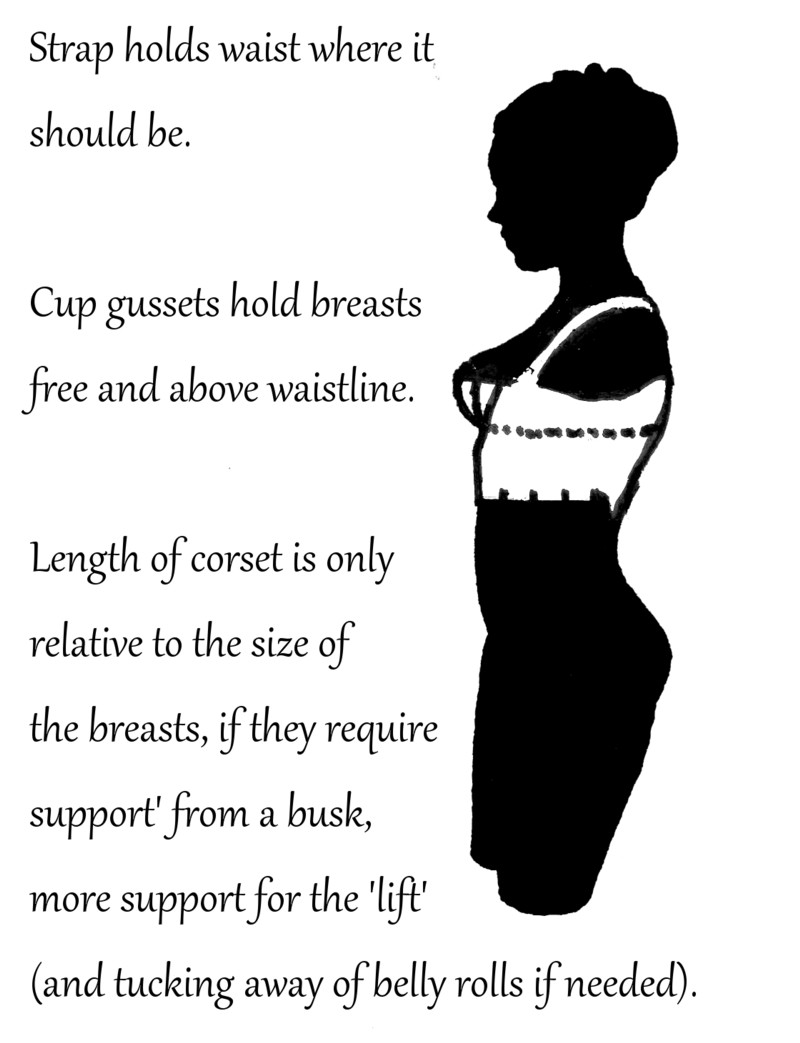
There are three key points on
a Regency set of stays that you must always address when constructing from a
pattern or drafting your own; 1) a clear waistline, with the breasts
securely held aloft above it. 2) Well measured shoulder straps. The length of
your straps will determine where your waistline falls, remember that. If your
straps are too long, your stays will drop down below the chest-line and mess
with the fit of your gown. 3) The gussets—which are pretty important and should
be designed to cup and hold the lower hemisphere of your breasts.
Gussets are key. Some
people believe that with larger breasts, you should lengthen your gussets, which
means, deepen the cups, and place your breasts closer to where they naturally
rest, right in the middle of your waistline. Gussets can be somewhat
lengthened if you do it intelligently, and you cut an arc in the cup before you
cut the slits in for the gussets. The trick really is to WIDEN your cups
if you want to accommodate larger cup sizes. You should be building sideways,
not up or down. You are broadening the platter in which your bust should
lay, instead of deepening it.
There are a couple of ways of
giving that top binding of your cups the strength to cup the bosom. You can
install a drawstring along the front of your stays to bring the edges of your
‘platter’ in, or you can bind it tightly so that it pulls the fabric in by
itself. I’ve also seen some designs where the creator made cutouts for each
breast rather than gusset slits, and then make gathered/ruched half-cups to fit
into them wherein their bosom can nestle.

Now many women are concerned
about ‘spillage’. The rule of thumb is this, your gusset cups should not
cover much more than the lower half/hemisphere of your breasts. The nipple
should be just barely covered by the edge of your binding, or even
half-covered. The top half of your breasts should be pillowed in the
cups. What keeps them from falling out is the neckline of your
shift. The shift is an essential partner in the team that is your Regency
underpinnings, and it acts like the top half of your bra. You really
should not wear one without the other.


- Cut your gussets or cups to cup the lower half of your breasts, beginning above the empire waistline.
- Your straps should be short and should hold your stays in place Protect the high-regency waistline
- Use the shift’s drawstring neckline to retain the upper half of your breasts.
- Use a busked corset if your breasts require dividing, or they are large enough to push the whole construct forward with just boning.


47 comments:
Fantastic explanation and great illustrations! All your posts are so helpful and informative, but of course the costume-related ones are my favorites.
Okay, so I LOVE this post. I keep coming back to this site over and over for the purely educational and practical application aspect. I'm looking at having to make a new set of stays for next season, so this is very timely for me. Since Victorian was my first era to dabble in, I've always had trouble just leaving the regency long corset lightly on the figure and focus just on support. I keep wanting to cinch in the waist, which creates the wrong shape. THANK YOU! LOVE your drawings and illustrations. They are SO helpful!
Wow! Thanks for the feedback! I'm always wondering if my posts are really helpful! It's good to hear that they are. I appreciate your comments and feel free to propose new ideas for posts whenever you please. :)
I truly enjoyed this post, as I think the undergarments are really essential to create the perfect silhouette.In my opinion the same effort that usually goes into a dress should be spend on the underpinnings, too!
Thank you for sharing!
Sabine
Thank you for this post! This answers nearly every question and uncertainty I've had about making my own Regency stays. I have a larger bust, so this will help me fit my stays when I make them. Now I know that when I put on my stays and look down, if my eyes go like this O.O, then I've done them correctly. Lol.
Adica
Very good explanation! It answered many questions for me.
Thanks for the post.
Great illustrations! Absolutely worth a thousand words. I love love love this blog!
I would love to see more fitting help (or alternatives) for ladies with very small busts -- I'm a 28 or 30 B and at my size the whole concept of a gusset is a bit of a joke.
This is such a great post! It's so frustrating to see people going to the trouble of making stays and then wearing them incorrectly. It's all about the shelf ladies...small, medium or large. :) Absolutely spot on and instructional illustrations as well! Thanks!
Excellent analysis of how the stays work, and so clearly stated. The supporting graphics are spot on. So much of great fashion of any era involves fitting it to the person. Thank you so much for posting this!
Bravoooo, bravoo!! This article is a boon to thousands I am sure. I have been intimidated at the thought of making my own stays but have recently decided to "just do it". This information has forwarded my cause considerably. I now know this is doable.
My pattern of choice is the Mantua-Maker Regency Stay pattern. I understand there will be more information there as well.
Me and the "girls" thank you for sharing this expertise.
Stephanie, what a great post! And I've seen it linked now from several blogs and the Sense and Sensibility page! You are a great resource!
Very Nice. I love this post
For best deal of Corsets tops visit https://www.corsetsqueen.com/
I just came across this article via Pintrest.
Absolutely fabulous! There is information here that I had never come across & I thought I was reasonable well versed in Regency attire.
I have mainly made Regency gowns for theatre where it's wasn't necessary to use authentic underpinnings, so finding this was perfect timing as I have been making a set of Regency stays for myself (I'm taking part in the Historical Sewing Fortnightly Challenge) & thought I'd made them wrong, as the gusset barely covered my nipples.
Thanks so much for the help with finishing my corded stays.
What would you do if you have large breasts but a small ribcage and there isn't any room for a busk? Or does the busk not sit between the breasts?
Thank you for this very helpful article. I had a pair of short stays draped for me. How do I "seperate" with the lacing in the front? I've boned this area but don't think it will completely sit flat. (Nothing ever does.)
Thanks in advance!
Anna
Ok now I definitely know that I need to PURCHASE. my stays. Where would I do that?
My book The Lady's Stratagem: A Repository of 1820s Directions for the Toilet, Mantua-Making,
Stay-Making, Millinery & Etiquette contains a large amount of original information on making quite a number of styles of stays for the period, with diagrams and instructions. Details are at www.lavoltapress.com.
I am very petite and have small 'girls'. Would short stays be best? I am not a very experience sewer, and want to give this a go. Cording seems very daunting to me, but I guess it had to be done, right?!
Thank you for this post!!
I am very petite and have small 'girls'. Would short stays be best? I am not a very experience sewer, and want to give this a go. Cording seems very daunting to me, but I guess it had to be done, right?!
Thank you for this post!!
Hello Juliette, the answer is yes, short stays will work beautifully for you. You have the ideal body for Regency garments, petit with modest girls. :) You do not have to do cording if you do not want to. The Sense and Sensibility small stays pattern is relatively easy to do (the hardest bit are the gussets, but they are manageable). You can just put it together simply, and add embroidery, cording embellishments later on, whenever it suits you.
I also recommend that you look at the following post: http://oregonregency.blogspot.com/2010/06/overview-of-regency-stayscorsets.html for tips on what type of corset works best for what body type.
Amazing post! But, does anyone have advice on making one with uneven breasts?
Thanks so much!
Almost everyone has uneven breasts. Do you have a sewing buddy? Or even a conveniently located mirror?
Accomodation for lopsidedness is much easier, I think, in Regency stays, provided you get the baseline right to begin with.
By this i mean the point where your breasts are poking out of holes in the foundation. If y you get the shape, height and angle of your personal curves right, everything else works.
Easiest next step is gathered cups as they'll accommodate different sizes. But if you have a buddy playing all about with gusset shapes should not be very difficult.
Love this article - so extremely helpful and informative! I have a question though - can stays that lace up the front accommodate a busk? I will need that as I have a large bust, but I don't want stays that lace up the back because I want to be able to lace them myself. Thank you!
Try fan lacing which allows rear eyelets to be tightened from the front. It has the added benefit of making adjustments easy as the laces slip more easily through the eyelets. For each pair of eyelets, laces go: gathering pad at R front - round waist R across to eyelet L then eyelet R (effectively forming an "X") then round wist L to gathering pad at L front. The two gathering pads then each have a single non-slip lace which is tied at the front. Uses a LOT more lacing but looks fantastic and is period appropriate.
Just to let you know - the info on how to form the gussets has been invaluable to me. And I tend to link this page when any question comes up that is remotely connected to the whole issue of regency-ish stays. Thank you!
In all of the costume patterns for corsets/stays, I am finding metal eyelets. Is that what they used during the Regency or is that a modern-day suggestion to reinforce the eyelet so it doesn't tear? I want to be as authentic as possible.
Hi Donna, if I am doing a quick corset for theatrical purposes, I use metal eyelets. But if I am making a H.A. set of stays then I hand button hole stitch the holes.
Hi! I'm working on a new set of back closing stays for myself and I'm running into problems with the entire concept of a busk. After some serious consideration I realised I have yet to make a pair in which the busk actually sits flat against my sternum, all the way up. It's fine right until it gets to the empire waist, then it sticks out. This isn't visible when the dress it on in any way. My concern is more that the separation and lift of the breasts is not being appropriately achieved.
With the new set I had the idea to use some very thick cording instead of a wood busk for a change. The same problem described above occurred and the top of the stays sort of stuck out all the way across the front.
I pulled out the cording and put a wood busk in instead and ended up with a similar result.
Initially I thought the problem was that bust inserts were too small, but I'm not thinking that's the problem since upon inspection the cups are too large to fit without a drawstring in the top casing. I tried two different cheimses under the stays, one with a drawsting in the neckline and waist, and one that's more of a stright shift with very little difference in the fit between them. I'm rather at a loss for how to get this busk to lay flat and actually do its job. Any ideas would be appreciated.
~M
1. Amazing. Why is this page not the first one google shows?
2. Where would you suggest getting a busk from?
3. Please don't ship your trolls to Australia, we have enough here. ;-)
It used to be first. The lack of updates has made it slip. I made my busk from two laminated paint sticks
This is such a good resource. I don't know if comments are still read at this point, but I wanted to ask if anyone has advice about getting lift and support with a small bust. I'm an A cup at best, and I just can't figure out how to get anything other than a flat chest with my long stays.
Being totally honest, the stays are only as really long as they need to be to support the bust. A smaller bust has no need for long stays BC they aren't used to shape the rest of the body during this time period. Moving into the 1820s and 1830s, the long stay became the norm, but an A cup wouldn't need a very long pair at all. That said, I would recommend either one of two things:
A) Bypass the stays entirely and go for a bodices petticoat instead. You can cord or otherwise stiffen the bodice of the petticoat to do much the same thing as a pair of stays.
B) Pad the cup portion of your stays. My understanding is that padding was used a bit less in women's garments during this period, but padding has always been a popular way to achieve a particular look.
I personally prefer a trapezoidal or triangular gusset or gore instead of the gathered cups seen in many of the transitional examples. Make sure you get the position of the underbust correct and cut your inserts with a tad more room than you might otherwise need, and then pad the lower portion where the inserts connect to the body of the stays. It should act similarly to the idea of the modern padded bra.
I also find it's important that those cups sit ever so slightly wider on the garment than you might think they need to be in order to achieve that lifted but separate look that seemed to be so popular. If they open at the front, make sure you stiffen on either side of the lacing. If they open at the back, short stays might only need some cording at the center front in place of a busk found in longer versions.
I do have both short and long stays for myself, but the cut at the top is more or less the same: wide set cups, stiffen between cleavage, pad where needed.
I hope this helps!
Yes, same! I'm an AA cup and I have felt so lost in my attempts at making stays.
Oh this will be so helpful. I'm incapable of tackling easy beginner projects when starting hobbies because they bore me, so I decided the puzzle of drafting my own set of regency stays would be a good enough puzzle to keep me entertained for awhile but I was having trouble determining where the top of the stays should hit and the best way to accommodate two very different sized girls. This should be very helpful! Now back to my soon to be very large pile of mock ups!
Thankyou, I drew up my regency stays and fitted a mock-up where they lifted wonderfully but I was worried my larger bust and about 60% nipple coverage was wrong but with the chemise it works wonderfully
This information was so helpful! Thank you so much for taking the time to explain about bust fitting. You made my corset project feel less intimidating.
I'm considering making a set of stays as an alternative to a bra, which I found unbearably uncomfortable. I'm not remotely symmetrical, and am not planning to wear them with period clothing (so no chemise underneath). Any suggestions on adapting the design to wear under modern clothes (not t-shirts, but dresses and blouses).
Your best bet is to add some "chops" underneath your girls for a little boost, or sew some quick pinched at the bottom of each cup-gusset
You can lengthen your straps to lower the waistline.
This information is so helpful. I’ve got my pattern drafted but I’m running into a tiny technical issue that I can’t find addressed anywhere. Modern patterns always tell you what direction the fabric grain should run on each piece. So far I haven’t found any guidance as to the direction of the grain for the pieces of short stays. I’m assuming that this is kind of critical to getting the right fit and the desired result. Could anyone offer any guidance?
The post that you share are also very good.
cord set for women
vt601by61s
golden goose outlet
golden goose outlet
supreme outlet
golden goose outlet
golden goose outlet
golden goose outlet
golden goose outlet
golden goose outlet
golden goose outlet
golden goose outlet
An automatic ironing machine takes the hassle out of ironing by using a combination of steam, heat, and automated settings to remove wrinkles effortlessly.
Buy shiva wall posters
shiva wall posters
Very practical and useful information.
Post a Comment